2025 Art Curators Conference
May 1–2, 2025, New York City
The AAMC Foundation's 2025 Art Curators Conference was held on May 1 and 2 in New York City. The annual Art Curators Conference brought together art curators from across the world to connect, explore leading subjects in the curatorial field, and engage in open dialogue.
The 2025 Art Curators Conference explored trends in curatorial hiring practices, sustainability practices in museums, AI and curatorial practice, the role of Black gallerists in advancing the gallery ecosystem, visitor-centeredness and collaborations with educators, and maintaining community partnerships in shifting political environments, among other topics.
The 2025 Conference also marked the return of RoundTables, small-group discussions where members explored topics facing the field at large. These open conversations were designed to catalyze lasting cross-institutional discussions on best practices in the field. RoundTables took place on Friday, May 2, from 12:30–1:30 PM in the main Conference ballroom.
All sessions were held at The Prince George Ballroom. The Members' Party took place on May 1 at the Asia Society Museum. Conference attendees were also invited to a Tour and Lunch at Hauser & Wirth Gallery on Thursday, May 1, from 1:00–2:00 PM, featuring the exhibition "William Kentridge: Self Portrait as a Coffee-Pot".
To ensure the Art Curators Conference was accessible to curators everywhere, the 2025 Conference was held both in person and virtually. Select session recordings were made available to attendees following the event.
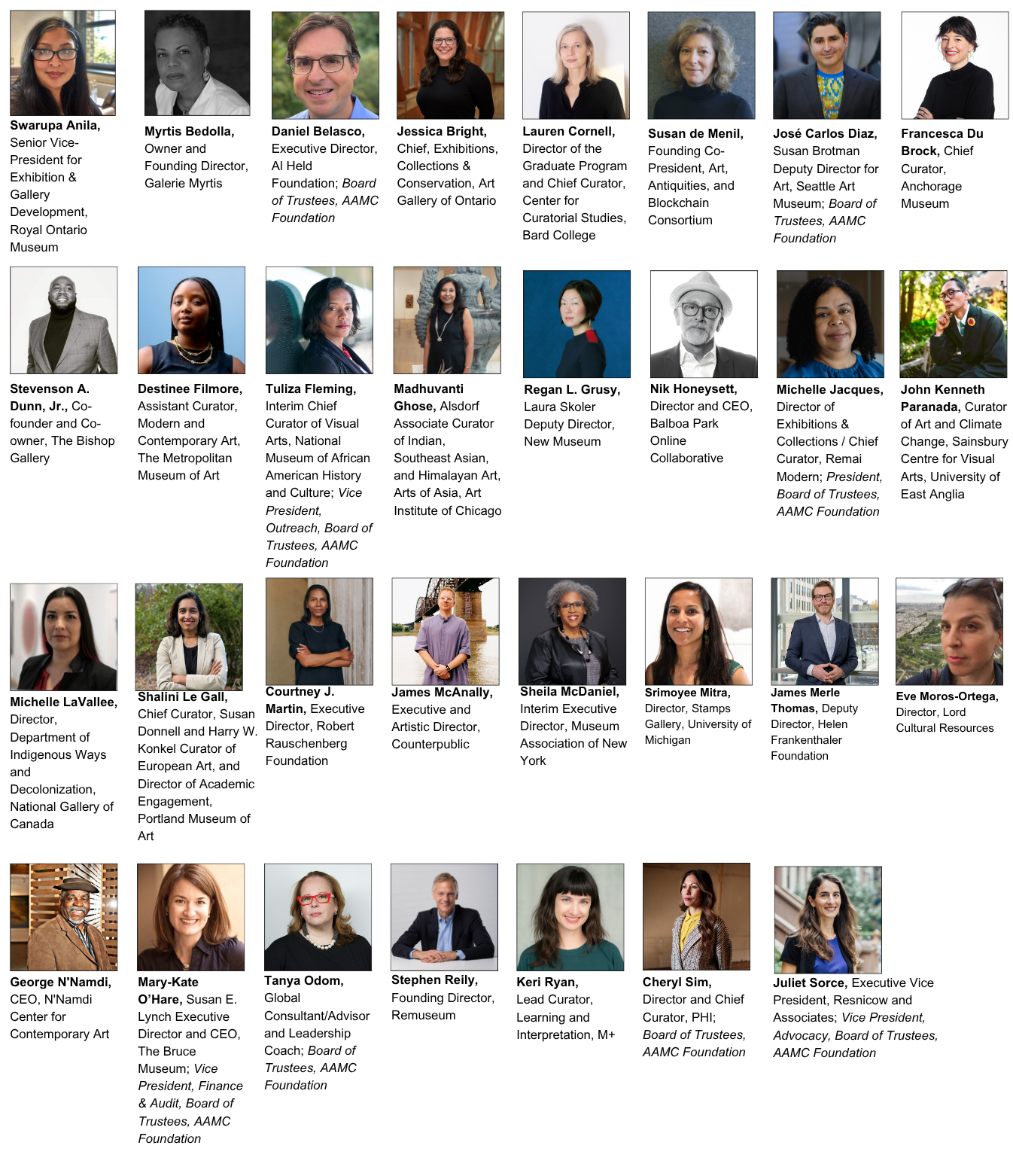
SPEAKERS
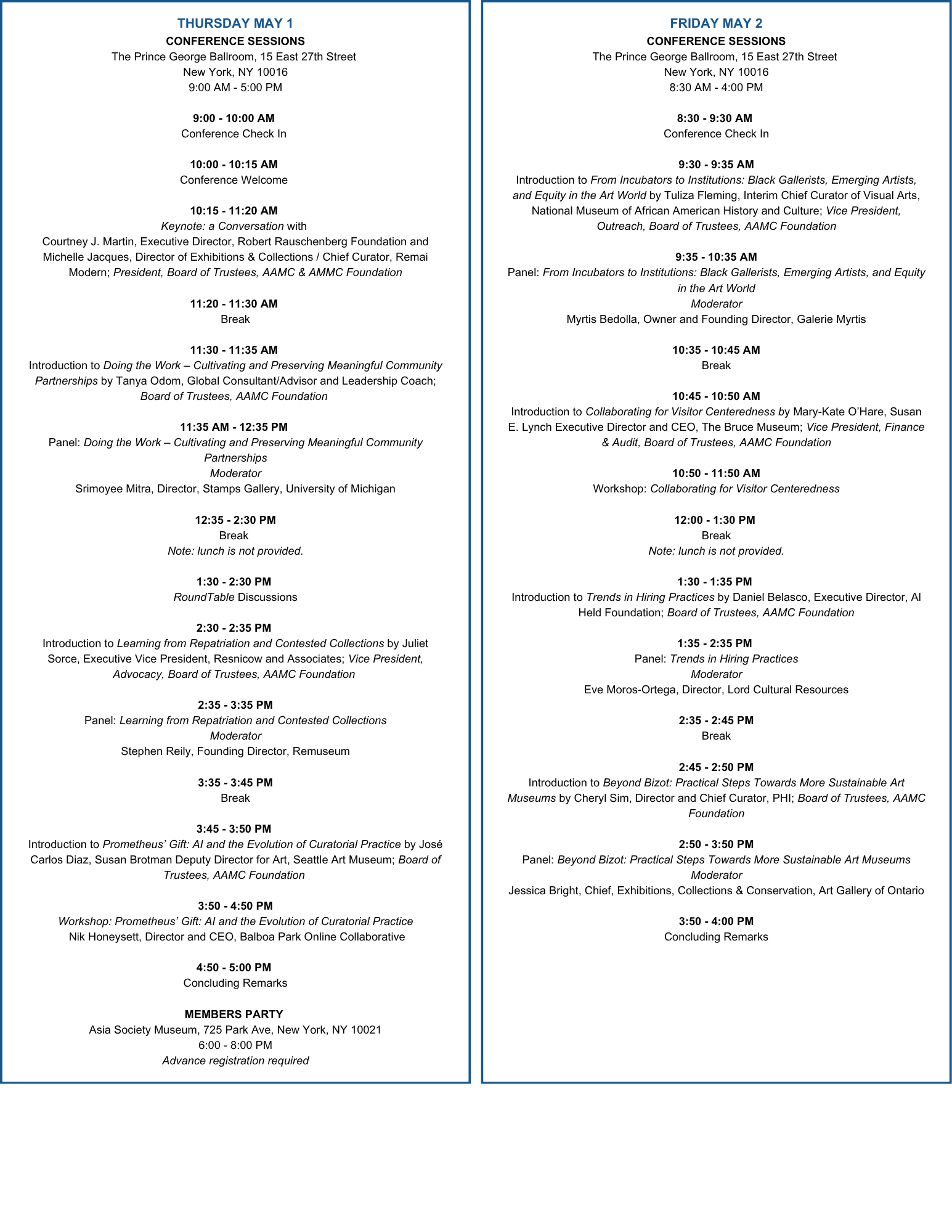
SCHEDULE OF EVENTS
PANELS & WORKSHOPS
-
Moderated by Jessica Bright, Chief of Exhibitions, Clolections & Conservation and Program Director, Dani Reiss Modern and Contemporary Gallery
How are institutions, big and small, implementing sustainability initiatives, from re-thinking courier protocols and loan agreements, to evaluating storage and conservation standards? -
Co-moderated by Swarupa Anila, Senior Vice President, Exhibition & Gallery Development, Royal Ontario Museum & Keri Ryan, Lead Curator, Learning & Interpretation, M+
The collaboration between curators and educators is key to creating successful visitor experiences in the museum. Through group activities, participants will wrestle with decisions and choices that consider the curator’s role in developing gallery experiences to serve target audiences. -
Moderated by Srimoyee Mitra, Director, Stamps Gallery, University of Michigan
Curators are often at the forefront of bringing forward and advancing justice oriented community engaged programs in their institutions. In the US, Canada, and beyond, many art institutions are rolling back their community-response programs, in fear of dwindling donor support and political backlash. How do we, as curators, continue to advance this work in an age of misinformation, confusion, and fear, where toxic polarization is being weaponized politically? What strategies have curators and institutions used to plan for anticipated criticism of exhibitions or programs? How do we maintain our personal and professional ethics and morals when our core values are challenged?
-
Moderated by Myrtis Bedolla, Owner and Founding Director, Galerie Myrtis
Black-owned galleries have been crucial in supporting African diaspora artists, helping them gain visibility and establish successful careers. These galleries provide essential advocacy, market positioning, and institutional partnerships that foster talent and shape the art world. As artists gain recognition, their relationships with galleries evolve, often presenting challenges. This discussion explores the strategies and challenges of supporting Black artists in the contemporary art market while emphasizing the vital role of Black-owned galleries in sustaining their success.
-
Moderated by Stephen Reily, Founding Director, Remuseum
For many years, museums have been addressing their responsibilities regarding art over which others may have claims. While some of those claims have led museums to return art to others, they have also inspired museums to explore new models of ownership and interpretation. Introducing new voices and new concepts of ownership regarding contested collections has, in turn, inspired new modes of interpretation in all areas of art – at least that is the concept presented by this panel discussion, which explores how a binary concept of cultural heritage (is it “ours” or “theirs”?) has adapted, and how it has generated a more nuanced and adaptable approach to the way curators talk about all the objects they share with the public.
-
Moderated by Nik Honeysett, Director and CEO, Balboa Park Online Collaborative
This session explores the growing potential of AI to revolutionize curatorial practices, from enhancing collections analysis to generating creative exhibition ideas. Through live demonstrations with ChatGPT, participants will experience how AI can streamline curatorial work and inspire new approaches to interpretation and engagement. Attendees will receive practical insights into how to begin using large language models (LLMs) and AI in their everyday tasks, as well as participate in an interactive ideation session to brainstorm exhibition topics and themes.
-
Moderated by Eve Moros-Ortega, Director, Lord Cultural Resources
As the art world evolves, so too does the role of curators, leading to shifting hiring practices across museums and institutions. This panel will explore the growing trend of curators moving between jobs more frequently, driven by factors such as institutional restructuring, evolving job descriptions, and the increasing demand for curators with diverse skill sets. How can curators prepare for digital engagement, community outreach, and collections management, in addition to traditional art history scholarship? What is the impact of temporary and contract-based positions, and what is the importance of flexibility and adaptability in curatorial career development? What do curators stand to gain by operating outside gallery/ institutional walls? What do they stand to gain? How can those who are hiring curators for their institutions ensure employee retention?
-
Applying Sustainability Standards in Curatorial Work • Deaccessioning and Collection Refinement • Balancing Workloads • Cross-Field Collaborations • Non-Western Provenance Research • Curator and Educator Collaborations • Sustaining Community Partnerships • AI and Curatorial Practices • Trends in Hiring Practices